The UK is switching off its traditional copper landline network by 31 January 2027. If your business still relies on a landline plugged into the wall, this deadline affects you directly - and for businesses, the standard fix isn't always the best one.
What is the UK landline shutdown?
The UK's copper telephone network, known as the PSTN (Public Switched Telephone Network), is being retired nationwide. It's being replaced by digital, internet-based phone services, often called VoIP or Digital Voice, which connect through a broadband router instead of the traditional wall socket.
You can read the official guidance on the GOV.UK Analogue to Digital Transition page.
The final deadline is 31 January 2027. Most residential customers will already have been migrated before this date, but as of August 2026, an estimated 1.5 million connections in the UK still needed to switch over. This later deadline is largely there to give telecare and other vulnerable customers extra time to migrate safely.
If your business is still using a traditional landline plugged into the wall socket, you should assume you'll need to act before this date, if you haven't already been contacted by your provider.
What this means if you run a business
For a household, switching to Digital Voice is usually a simple case of plugging the phone into the router instead of the wall. For a business, it's worth pausing before doing the same thing.
The adapter isn't the only option
Digital Voice still ties your business number to a single physical connection: one router, one office, one adapter. If that connection goes down, so does your only way of being reached on that number.
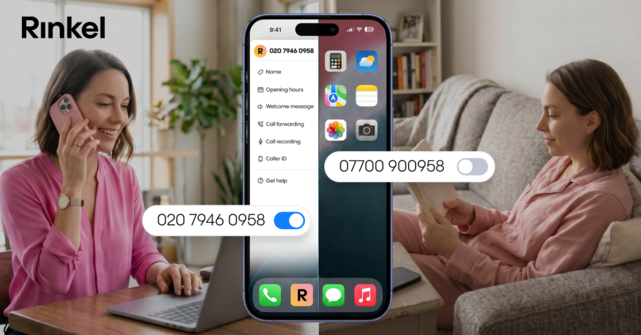
A business phone system that runs through an app works differently. Instead of a number tied to a socket or an adapter, your business number lives in an app on your phone or laptop, and calls can be answered from anywhere with an internet connection, not just the one router it's plugged into.
What happens during a power cut?
This is the risk that matters most for businesses. A Digital Voice adapter needs mains power and a working router to function, so a power cut at your office takes your landline down with it, exactly when customers might be trying to reach you.
An app-based business number doesn't have that single point of failure. As long as you or a team member has a phone with mobile data or Wi-Fi, calls to your business number still come through, even if the office itself has no power.
Just like with Digital Voice, switching to a cloud-based business number doesn't mean losing the number your customers already have. Numbers can be ported across to a new system, so there's no need to reprint stationery or update your Google Business Profile.
What about devices that rely on your landline?
Not every device on a landline is a phone. Businesses should also check:
- Card payment terminals (PDQ machines): some older models dial out over a phone line and may need updating
- Alarm systems and CCTV: older security systems sometimes use a phone line to report to a monitoring station
- Fax machines: still in use in some sectors, and not all fax machines work reliably over Digital Voice
If any of these are connected to your landline, contact the equipment provider to confirm it will keep working after the switch, rather than assuming it will.
Do you need broadband to make the switch?
Not necessarily. Most people and businesses will use their existing broadband connection for Digital Voice. Providers do also offer landline-only options for those who don't want a broadband connection at all.
That said, if you're weighing up your options anyway, it's worth comparing this against a fully app-based virtual phone number, which doesn't require a landline socket, router-based adapter, or any new hardware at your premises.